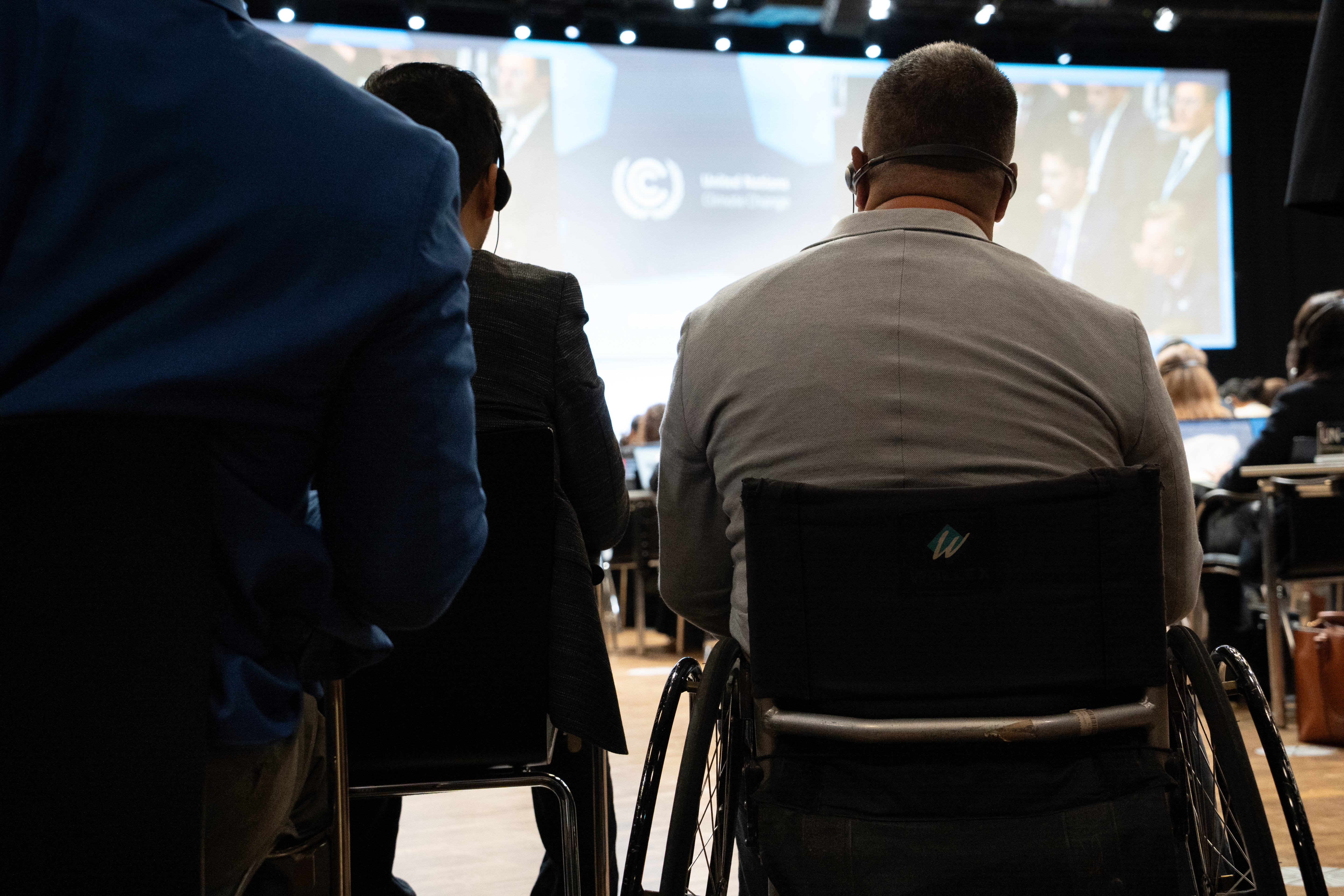
One of the smallest rooms at a global climate conference left the largest impression on me. Walking into the Disability Caucus meetings felt different from entering many of the other spaces at the UN Conference Center in Bonn, Germany. Most rooms were large, designed to accommodate negotiators and observers gathered from around the world, to discuss and draft international climate policy. But tucked away in a corner, down a hallway from the venue’s sprawling, glass-walled atrium, was the small, unassuming room where the Disability Caucus met. Its size and simplicity stood in stark contrast to the other meeting spaces I had visited throughout the week.
This June, I attended the second week of the United Nations Framework Convention on Climate Change (UNFCCC) Subsidiary Bodies meeting (SB 64) in Bonn, Germany. Throughout the week, I witnessed both the progress being made toward disability inclusion in international climate negotiations and the barriers that continue to prevent persons with disabilities from having an equal voice in shaping climate policy.
During a Just Transition Work Programme negotiation session, I watched countries debate whether vulnerable, frontline groups such as women, youth, Indigenous Peoples, and persons with disabilities should be explicitly named in the official negotiating text. Some parties expressed concern that listing specific populations would create an ever-growing "shopping list" of people, favoring broader terms like "vulnerable groups”. One argument for using broader language was that explicitly naming certain populations could imply that others not listed were intentionally excluded.
While broader language may appear more inclusive, it can obscure the distinct barriers faced by different populations. When persons with disabilities are not explicitly recognized in climate policy, their needs risk being overlooked in the funding, planning, and implementation that follow. A March 2026 European Disability Forum policy brief, Disability Inclusion in the UNFCCC Process, warns how grouping persons with disabilities under vague terms like “vulnerable groups” can contribute to a lack of dedicated funding and resources to address their specific needs in climate action. For disability advocates, such as the International Disability Alliance and the African Disability Forum, who have spent years fighting for recognition in international climate policy, even a few words of inclusion in a negotiating document can represent years of advocacy.
Climate change disproportionately impacts persons with disabilities, who comprise 16% of the global population. During climate emergencies, they face mortality rates two to four times higher than the general population. Climate change can exacerbate existing health conditions and socioeconomic inequalities endured by persons with disabilities. These disproportionate impacts are compounded by inadequate disaster planning. According to the UN’s 2023 Global Survey on Persons with Disabilities and Disasters only 8% of respondents reported that local disaster risk reduction plans addressed the specific needs of persons with disabilities. Despite experiencing greater climate-related risks, persons with disabilities have historically lacked the same formal representation in international climate negotiations as other stakeholder groups.
After years of navigating attitudinal, legal, and physical barriers for a seat at the table, the inclusion of persons with disabilities in climate discussions has finally moved one step forward. In February 2026, the UNFCCC formally recognized the establishment of the Disability Caucus, a collective platform representing 120 organizations of persons with disabilities (OPDs).
Countries lead the formal negotiations, but they are not the only voices involved. Constituencies, officially recognized formal groups of observer organizations that share common interests or perspectives, also participate. The UNFCCC recognizes nine formal constituencies including groups such as Indigenous Peoples, women and gender groups, environmental organizations, and business and industry groups. Constituency status grants these groups opportunities to coordinate, bring their perspectives to the discussion, and contribute to proposals under consideration.
The creation of the Disability Caucus provides OPDs with an official space to coordinate and access limited-capacity negotiation sessions. While the Disability Caucus has received formal recognition, it does not yet have the established participation channels available to recognized constituencies. As a result, members must often rely on relationships with other countries to bring disability-related priorities into negotiating discussions.

As someone new to international climate policy and diplomacy, I found that the discussions in the Disability Caucus meetings were easier to follow than the language within the policy negotiation rooms. Engaging in these caucus discussions taught me the most about how the conference functions and how observer groups influence negotiations.
Much of the Disability Caucus's work happened outside the formal negotiation rooms. Members divided up to attend different negotiation sessions, tracking which countries advocated for persons with disabilities to be explicitly mentioned in draft texts. Without constituency status, members often had to work through other parties and groups to bring disability-related priorities into negotiations. Before arriving in Bonn, I expected to deepen my understanding of international climate policy while observing the negotiations themselves. Instead, I learned the most by speaking with other disability advocates and by watching their coordination and advocacy efforts behind the scenes.

My background in environmental health and my own experiences with chronic illness have shaped how I understand the intersection of climate change, health, and disability inclusion. Scientific research is essential, but it is only one piece in developing inclusive climate solutions. Witnessing the Disability Caucus's efforts to gain greater representation reminded me that participation in climate policy does not require being a high-level policymaker or an expert in international negotiations. Much of the work that shapes climate policy happens through the collaboration of people across different fields, including researchers, advocates, communicators, youth, and people with lived experiences.
As COP31 unfolds, I will be following the Disability Caucus's continued efforts to gain greater representation in climate negotiations. Though the Caucus met in one of the smallest rooms in Bonn, the work that happened inside demonstrated the strongest determination, collaboration, and advocacy during SB 64.